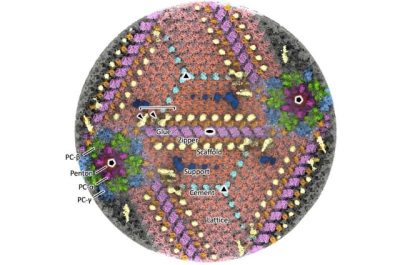
A research group has successfully determined, for the first time in the world, the capsid (outer shell) structure of Melbournevirus—a member of the giant virus family—at a resolution of 4.4 Å using cryo-electron microscopy (cryo-EM). The work is published in the journal Viruses. The team was led by Project Professor Kazuyoshi Murata at the Exploratory Research Center on Life and Living Systems (ExCELLS) / National Institute for Physiological Sciences (NIPS), in collaboration with Senior Researcher Kenta Okamoto at Uppsala University and Professor Chantal Abergel at Aix-Marseille University.
A giant virus encodes part of the protein-making toolkit of cells that gives it greater control over its amoeba host, raising questions about how it evolved and how such beings relate to living organisms
Sous l’effet du changement climatique, les zones arctiques se réchauffent deux à trois fois plus vite que le reste du globe, entraînant le dégel des sols de la région polaire.
Or, nous n’y trouvons pas seulement de la terre gelée : ces sols renferment aussi des bactéries et des virus anciens, parfois très anciens… qui sont alors libérés.
Ici la question n’est pas de céder au scénario catastrophe ou d’imaginer un énième spin-off de Walking Dead.
Mais de se demander très concrètement : que peuvent faire ces virus ? Quels risques représentent-ils vraiment ?
Et surtout, que sait-on — et que ne sait-on pas encore — de ces mondes microscopiques qui refont surface ?
Lurking in the vast expanse of the ocean and buried deep in the Siberian permafrost, there are giants—not blue whales and mammoths, but giant viruses.
Written byRebecca Roberts, PhD
Rebecca Roberts,PhD
Jan 2, 2026 | 7 min read
Les virus aussi peuvent être infectés ! Un virus géant infectant une amibe est lui-même attaqué par un virophage, à son tour influencé par un élément génétique mobile, un transpoviron. Une cascade d’interactions étonnante révélée par des chercheurs marseillais.
Alexandra Bessenay, dans le cadre de sa formation doctorale « communication et éthique du chercheur », a participé au podcast "PROFESSION CHERCHEUR / VIS MA VIE DE THÉSARD" organisé par L’Atelier-Studio d’Euphonia et Radio Grenouille.
Les virus géants infectant les amibes, des organismes unicellulaires eucaryotes, peuvent être parasités par d’autres virus, les virophages, ainsi que des éléments génétiques mobiles appelés transpovirons et contenus dans les deux catégories de virus. Dans une étude publiée dans Nature Communications, des scientifiques ont décrypté les interactions au sein de ce système quadripartite complexe en analysant l’expression de leurs gènes respectifs.
Our research over the last ten years has reliably and reproducibly demonstrated that viruses can remain
infectious after tens of thousands of years of freezing (48,000 years) in deep permafrost [1-3]. For
obvious health safety reasons, our work was restricted to viruses infecting amoebae, but there is no reason why this conclusion could not be applied to other DNA viruses (classified in the same phylum, such as poxviruses, iridoviruses, or asfarviruses) causing diseases in humans or animals...
Ma thèse en 180 secondes permet aux doctorants de présenter leur sujet de recherche, en français et en termes simples, à un auditoire diversifié. Chaque étudiant ou étudiante doit faire, en trois minutes, un exposé clair, concis et néanmoins convaincant sur son projet de recherche.
Un grand bravo à Alexandra qui a atteint la finale régionale!
Thanks to rising temperatures and melting permafrosts, certain ancient viruses are resurfacing... but just how dangerous to humans are they?
Threat of outbreak from microbes trapped in permafrost for millennia raised
by increased Siberian shipping activity
Jean-Michel Claverie et Chantal Abergel traquent les germes infectieux enfouis dans le permafrost.
Avec le réchauffement planétaire, ces agents pathogènes très dangeureux pourraient être libérés
CNN
Resurrection biology — attempting to bring strings of molecules and more complex organisms back to life — is gaining traction in labs around the world.
The work is a far cry from the genetically engineered dinosaurs that escape in the blockbuster movie “Jurassic Park,” although for some scientists the ultimate goal is de-extinction and resurrecting animals and plants that have been lost.
Other researchers are looking to the past for new sources of drugs or to sound an alarm about the possibility of long-dormant pathogens. The field of study is also about recreating elements of human history in an attempt to better understand how our ancestors might have lived and died.
Here are four fascinating research projects in this emerging field that launched or made significant progress in 2023.
Reviving ‘zombie’ viruses
Warmer temperatures in the Arctic are thawing the region’s permafrost — a frozen layer of soil beneath the ground — and potentially stirring viruses that, after lying dormant for tens of thousands of years, could endanger animal and human health.
Jean-Michel Claverie, a professor emeritus of medicine and genomics at the Aix-Marseille University School of Medicine in Marseille, France, is seeking to better understand the risks posed by what he describes as “zombie viruses” by resurrecting viruses from earth samples from Siberia.
There could be something big lurking in the Earth's permafrost...
Ancient pathogens that have been preserved in northern Russia’s permafrost for millennia could reawaken as global temperatures rise, scientists warn, potentially putting humanity at risk of never-before-seen diseases.
Jean-Michel Claverie, a virologist and emeritus professor at the Aix-Marseille University School of Medicine, is one of the few scientists worldwide who has studied “zombie viruses” in the Siberian permafrost. He warned they could be present in Russia’s frozen soil in a “very large number and diversity.”
A French virologist’s discoveries are raising fears that thawing Siberian permafrost could
bring ancient outbreaks back to life.
Avec le réchauffement climatique, la résurgence
de virus ou de bactéries jusque-là enfouis dans des sols congelés
depuis des milliers d’années est une source d'inquiétude
croissante.
March 10, 2023 – Of all the consequences of climate change, here’s one nobody counted on.
A team of European researchers digging into Siberian permafrost discovered and revived 13 types of prehistoric viruses. As the ancient frozen ground slowly loses its “perma” label due to rising temperatures, more and more microbes that have never encountered modern humans are resurfacing...
Le réchauffement climatique suscite de nouvelles inquiétudes chez les scientifiques. Ils craignent que le pergélisol qui a gelé pendant des années ne dégèle et libère les anciens virus piégés à l’intérieur.
“Ce risque augmentera certainement dans le contexte du réchauffement climatique, où la fonte du pergélisol continuera d’augmenter, et davantage de personnes habiteront l’Arctique”, a déclaré Jean-Michel Claverie, biologiste informatique à l’Université d’Aix-Marseille en France qui étudie virus anciens et exotiques, cité par CNN, dimanche (30/7/2023).
En raison de la fonte de la glace causée par le changement climatique, certains virus et bactéries très anciens et apparemment éteints, piégés depuis des millénaires dans le pergélisol (la couche gelée du sol souterrain), pourraient se réveiller et donner vie à de nouvelles maladies inconnues et à la propagation de pandémies avant l'extinction des mammouths et des Néandertaliens. Parlons des soi-disant "virus zombies" !